
For Mine Operators and
Land Rehabilitation Services
Post-mining land is not an environmental problem.
It is a balance sheet problem.
Every hectare of degraded land sitting under a rehabilitation obligation is a liability: unfunded, long-dated, and growing. Regulatory deadlines are fixed. Conventional approaches, lime, fertilizer, seeding, deliver partial results that require repeated intervention. The obligation does not close. It just continues to cost.
CarboSlag closes it.
Our pre-activated slag amendment restores post-mining soils at the biological level, not just the chemical one. It corrects pH, permanently immobilises heavy metals including cadmium and lead, rebuilds the soil microbiome, and sequesters carbon through two concurrent pathways. The land does not just meet compliance thresholds. It genuinely recovers.
What changes for you:
Statutory rehabilitation obligations met at lower total cost than conventional methods
Heavy metal immobilisation without excavation, significantly reducing intervention complexity
Reapplication frequency halved, reducing the long-term cost of ongoing land management
Restored land generates up to €8,000 per hectare in carbon credit revenue
1.6 tonnes of carbon sequestered per hectare annually, fully verified and certifiable
Why carbon?
Why it matters?
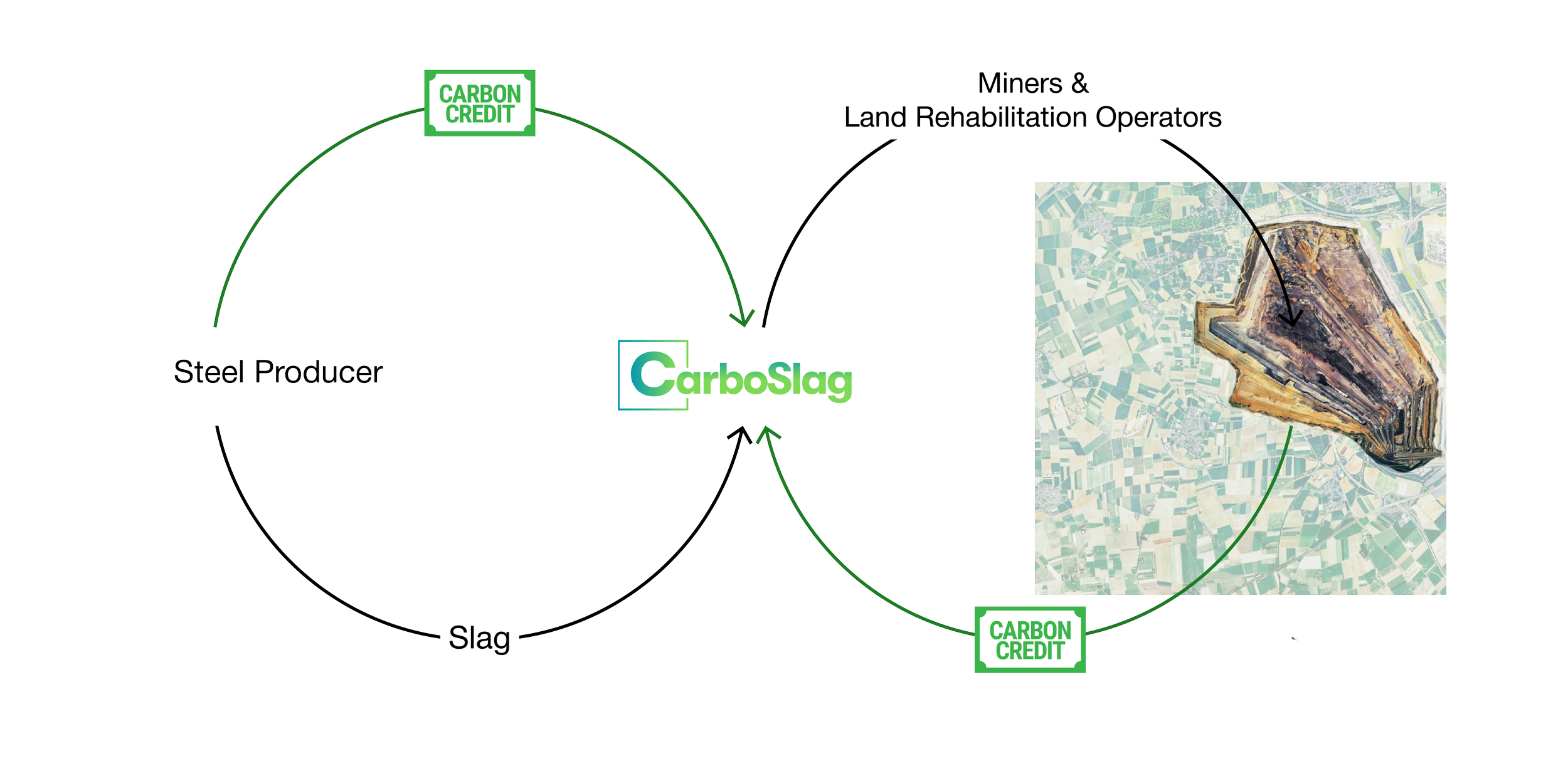
When degraded land is restored and begins storing carbon, that sequestration can be measured, independently verified, and issued as carbon credits. Each credit represents one tonne of CO2 removed from the atmosphere and locked into the soil. These credits are bought by companies and institutions with emissions reduction commitments, and they carry real market value.
CarboSlag manages the entire measurement, reporting, and verification process. You do not need to navigate the carbon market. You receive a direct share of the revenue your restored land generates, turning a long-term liability into an income-producing asset.
For operators in regions like the Rheinische Revier or Lusatia, where tens of thousands of hectares require mandatory restoration before 2035, that revenue potential is substantial. The obligation was always there. Now it comes with a return.